

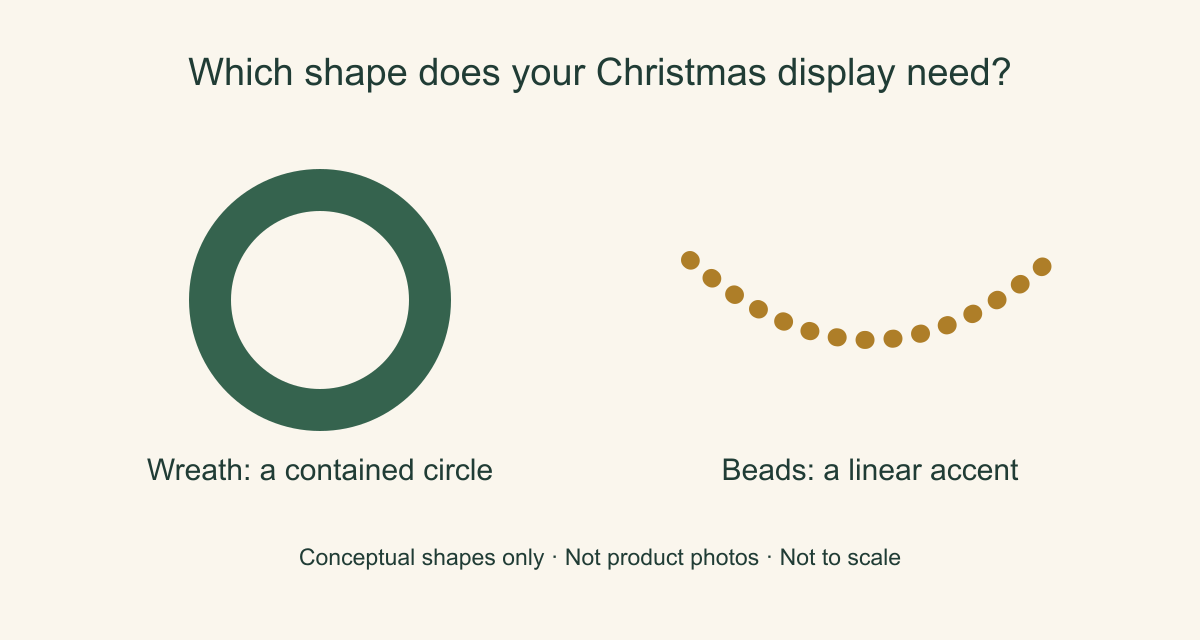
Choose a Christmas wreath if you want a defined circular feature; consider a bead garland if you want a line of decoration that follows a planned arrangement. Neither format is automatically better for a small room, and you do not need both. The useful question is what your Christmas display is missing: a focal shape, a connecting accent, or simply more space around the decorations you already own.
For Speckled Space shoppers, this comparison has a specific distinction. Bellery Christmas Wreath A is an artificial wreath listed at 50cm, while Gold Beads Christmas Tree Garland is a string of beads, not foliage. They offer different visual ingredients. Comparing them as interchangeable greenery would lead you towards the wrong purchase.
Start with the shape your display needs
A wreath gives you a contained outline to assess against its surroundings. A bead garland gives you a continuous strand whose appearance depends on the route you arrange it along. Treat a wreath as a possible focal point and a garland as a possible linear accent, rather than fixed rules: either can attract attention depending on placement and the rest of the display.
Look at Speckled Space’s Christmas wreath collection when the circular format answers your brief. Before choosing a design, describe the result you want in plain language: one recognisable festive shape, an accent among existing decorations, or a connection between separate elements. This keeps the purchase tied to your room rather than a styled photograph.
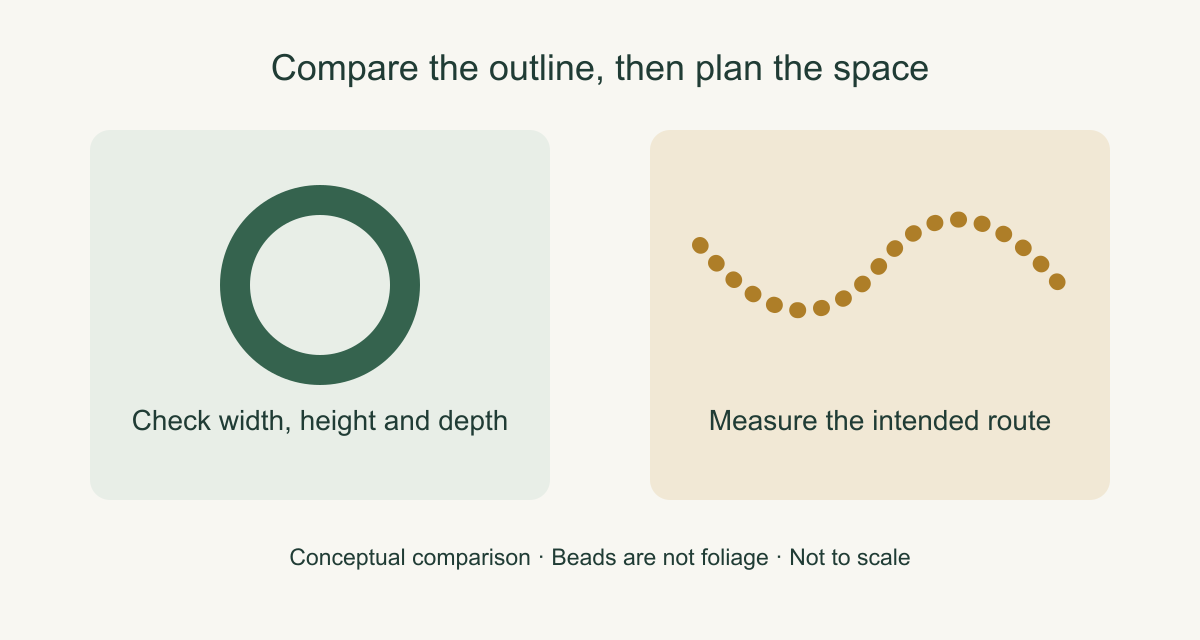
Compare the actual products, not just their names
The Bellery Christmas Wreath A product page identifies a 50cm artificial wreath with foliage. That measurement is a starting point for planning its outline; it does not establish the product’s depth, weight or suitability for your intended location. Check those details and the actual product instructions before settling on a display method.
The Gold Beads Christmas Tree Garland listing specifies a total length of 6m, an 8mm bead diameter and indoor decorative use. These describe a long, fine bead strand, not a leafy border. If your idea depends on greenery filling a broad area, this garland alone does not provide that material or shape.
| Decision | Christmas wreath | Gold bead garland |
|---|---|---|
| Visual role | Do you want a contained circular feature? | Do you want a strand that follows an arrangement? |
| Measurement | Compare the listed diameter with available width and height; confirm depth separately. | Measure the intended route, including curves; compare it with the listed total length. |
| Existing decor | Would foliage and a circular outline add something missing? | Would gold beads repeat an accent you already enjoy? |
| Viewing position | Can you see the outline clearly from your usual seat? | Will the bead strand remain visible among nearby objects? |
| Pack-away plan | Where will the wreath fit without forcing its shape? | How will you contain the strand and find its ends next season? |
Measure the display, including what stays in place
Start with the usable area, not the full furniture or wall dimensions. Which objects must remain? What space do you still need for everyday use? Record the width, height and available depth of the proposed display, then compare those notes with confirmed product measurements. Avoid treating the wreath’s stated diameter as its complete storage or display footprint.
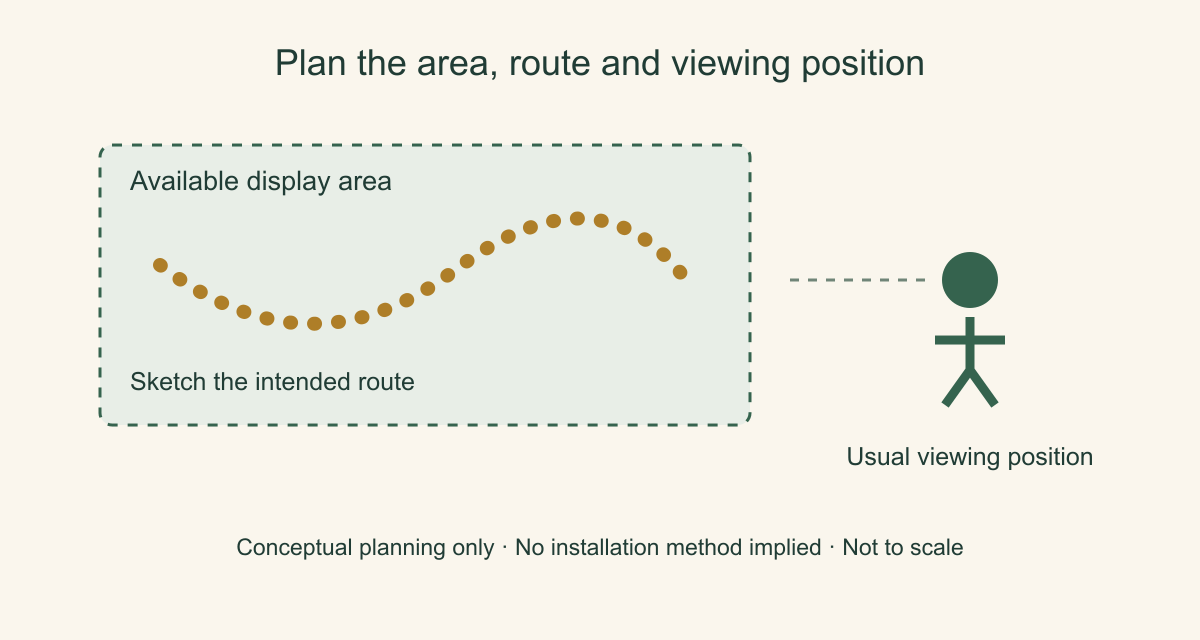
For the garland, sketch the intended path. A straight span and a curved arrangement are different measurement tasks, even when their endpoints are identical. Include the planned curves rather than ordering from the distance between endpoints alone. If the strand would be longer than your arrangement needs, decide whether you have a suitable use for the remainder; do not assume it can be cut or altered.
Keep this planning separate from installation. Check actual product instructions and property requirements before choosing a display method. A product photograph or a suggested styling location does not establish permission for your own property or confirm that a particular arrangement is suitable.
Judge the result from where you actually see it
Choose your main viewing position before refining small details. Is this a display you will mostly see from a sofa, across the dining room or close up? From that position, ask whether you can distinguish the intended outline and whether surrounding objects obscure it. A close-up shopping image cannot answer those room-specific questions.
Take a photograph of the undecorated area and sketch a circle or a bead route over it. This is a composition exercise, not a product preview. Try each option separately. If the circle competes with an existing centrepiece, reconsider its location. If the bead route disappears into a busy background, simplify the arrangement before adding more decorations.
Use existing Christmas decor to narrow the choice
Lay out the decorations you intend to reuse. Identify the colours, finishes and shapes already present, then decide what you want to repeat or introduce. Gold beads might be an option when you want to repeat a gold detail. A foliage wreath might be an option when you want a distinct textured circle. These are styling choices, not guarantees that either product will match everything you own.
Browse the Christmas decorations collection with that brief in mind. The collection includes different decorative categories, so the aim is to identify a missing role rather than assemble a matching item from every category. Compare the actual finish and appearance with your existing pieces before deciding.
If you are considering both formats, give each a reason to be there. For example, your plan might use a circular feature in one part of the room and a bead accent in another. Review the whole view together. If removing one makes the arrangement clearer and still delivers the Christmas look you want, buying both is unnecessary.
Make the pack-away decision before checkout
Ask where each item will live after Christmas. For a wreath, confirm the depth and any packaging requirements as well as the diameter. For a bead strand, decide how you will keep it contained and separate from other decorations. Do not assume either format takes less storage space without checking the actual item and your available storage.
Bellery Christmas Wreath A’s listed care instructions say to dust lightly with a dry cloth and store it in a cool, dry place away from direct sunlight. The garland listing specifies indoor decorative use but does not provide equivalent care or storage instructions. Check those details rather than transferring the wreath’s instructions to a different product.
Before checkout, you should be able to name the desired shape, identify the display area, record the measurements you need, describe the main viewing position and explain the pack-away plan. Choose the wreath for a deliberate circular feature or the bead garland for a deliberate strand accent. If a missing measurement or instruction could change that choice, resolve it first.


Leave a comment
This site is protected by hCaptcha and the hCaptcha Privacy Policy and Terms of Service apply.