

Christmas Tree Decorations Singapore: A Practical Buying Guide
Start with the tree and room, then buy decorations in layers: a coordinated bauble base, a smaller number of statement ornaments or picks, lighting that suits the palette, a proportionate topper, and a skirt or collar to finish the stand. For Singapore homes, the strongest plan is not the one with the most pieces. It is the one that fits the tree height, visible viewing angles, available storage and the colours already used in the room.
What to buy for a complete Christmas tree
A complete tree normally needs more than one box of matching baubles, but it does not require every decoration category. The useful starting point is to separate the job of each layer. Lights create depth. Base baubles distribute the main colours. Larger or more distinctive ornaments create focal points. Picks and poinsettias fill gaps. A topper finishes the vertical line, while a skirt or collar hides the stand and visible wiring.
This distinction matters when shopping for Christmas tree decorations in Singapore because buying individual pieces without a plan often creates two problems: too many competing colours and too few pieces that actually fill the tree. Choose the foundation first, then decide whether the display needs more texture, more scale or simply a cleaner finish.
| Decoration layer | Purpose | What to decide before buying |
|---|---|---|
| Lights | Creates an even glow and visual depth | Warm or cool tone, pre-lit or separate strands |
| Base baubles | Establishes the main colour palette | Two or three linked colours and a mix of finishes |
| Statement ornaments | Adds personality and focal points | Scale, material, weight and how often the motif repeats |
| Picks and poinsettias | Fills sparse areas and adds texture | Whether the tree needs volume, contrast or a softer finish |
| Topper | Completes the silhouette | Ceiling clearance, tree-tip strength and visual proportion |
| Skirt or collar | Conceals the base and cords | Tree-stand width, room style and storage space |
Measure the tree and room before choosing decorations
Tree height alone does not tell you how much decoration to buy. A slim 6ft tree and a full 6ft tree can require very different coverage because branch count, width and density change the visible surface area. Note the tree height, widest diameter and the number of sides people will see. A tree placed in a corner may need most of its decoration concentrated on the front and exposed side, while a tree in an office lobby has to look balanced from every direction.
Also check the distance between the top of the tree and the ceiling. That remaining space determines whether a tall star, bow or cluster of decorative picks will fit. At the base, measure the stand before choosing a rigid collar. A fabric skirt is more forgiving, while a collar needs enough width and height to conceal the stand without pressing against the lower branches.
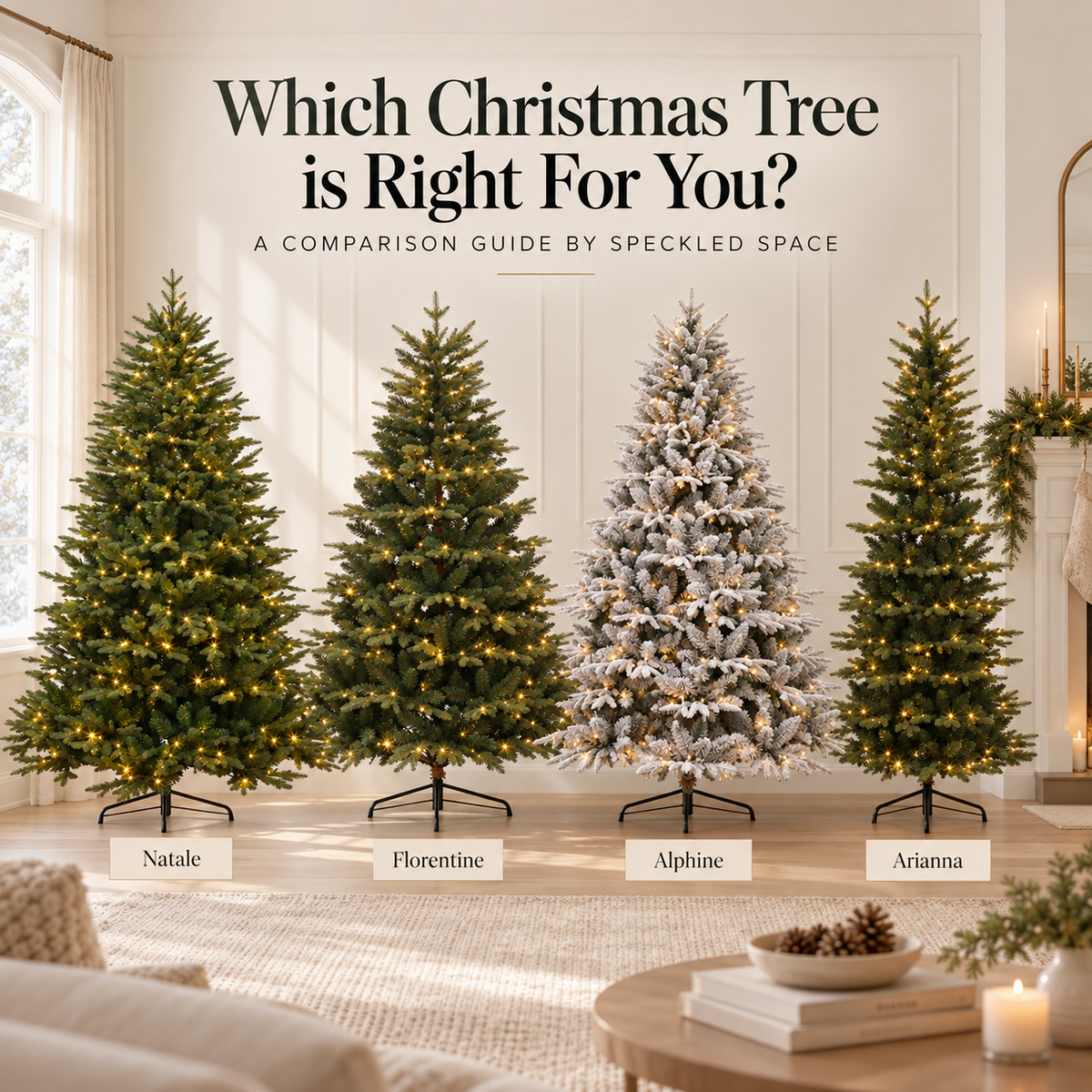
If the tree itself has not been chosen, compare the available artificial Christmas trees before setting an ornament quantity. The branch shape, existing lights and foliage colour should guide the decoration plan, rather than forcing a theme onto a tree that does not support it.
Choose a theme that works with the room
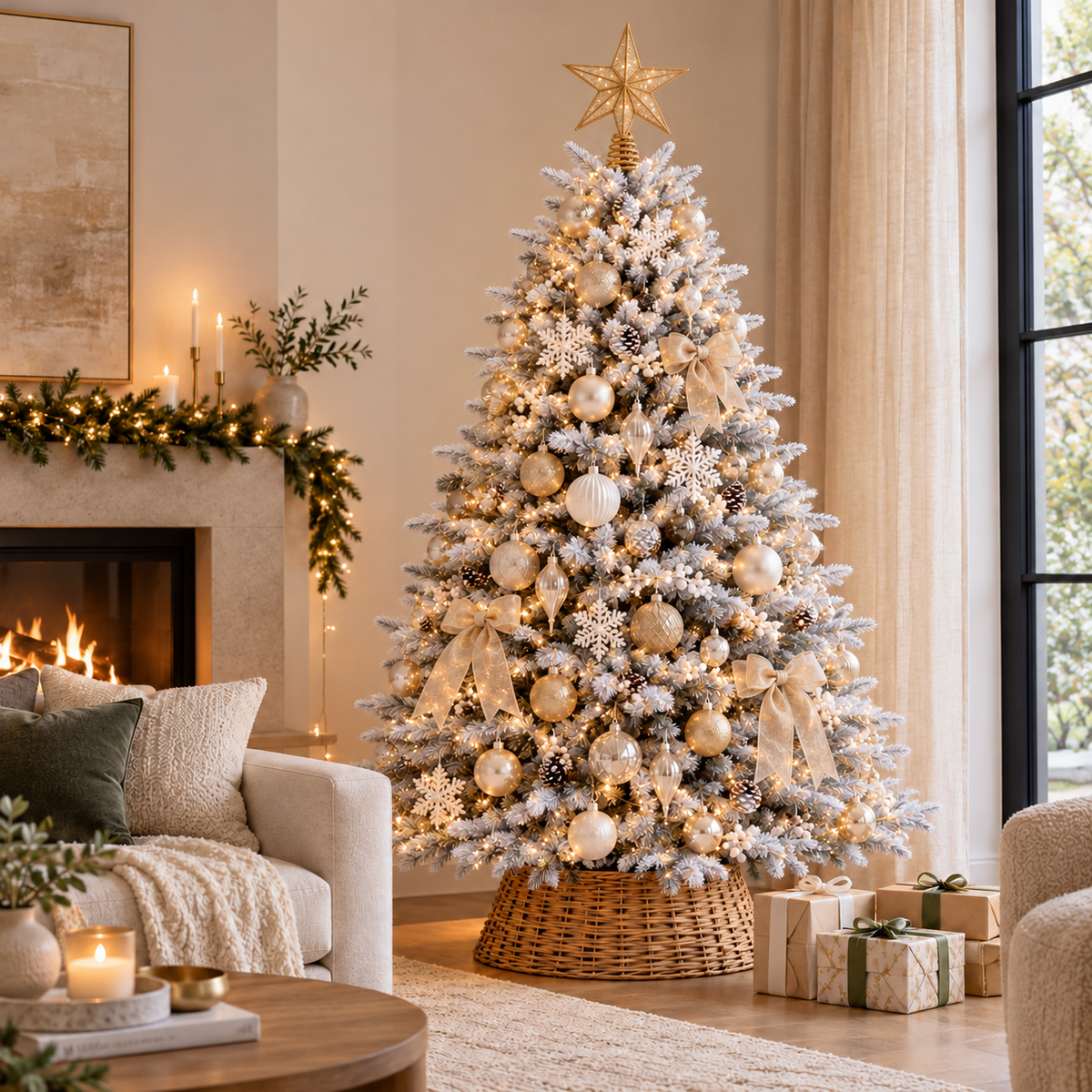
A tree feels intentional when its palette connects to the room around it. This does not mean every colour must match the furniture. It means the decorations should either repeat a few existing tones or create one deliberate contrast. For a neutral interior, champagne, soft gold, white and natural textures keep the display calm. Red and gold gives a warmer, traditional result. Blue, silver and white create a cooler palette that can work well in modern homes and offices. Candy-inspired colours create a more playful tree, but they need repetition so the design reads as a theme rather than a collection of unrelated pieces.
Limit the foundation to two or three dominant colours. Variation can then come from finish and texture: matte beside gloss, metallic beside velvet, or clear pieces beside opaque ones. Speckled Space groups its Christmas baubles and hanging ornaments by palettes including classic red and gold, gold-silver-white, blue and white, glamour gold and Candyland. Using one collection as the base makes it easier to add a smaller number of special pieces without losing visual consistency.
| Theme | Best suited to | How to keep it coherent |
|---|---|---|
| Red and gold | Warm, traditional family spaces | Repeat red at eye level and use gold as the connecting metallic finish |
| Gold, silver and white | Neutral or contemporary interiors | Let white soften the two metallic tones rather than adding another strong colour |
| Glamour gold | A richer statement tree | Mix finishes and sizes so an all-gold palette still has contrast and depth |
| Blue and white | Cooler modern or winter-inspired styling | Use silver or clear accents sparingly to connect the blue and white layers |
| Candyland | Playful family displays and colourful rooms | Repeat a few motifs across the tree instead of adding every novelty shape once |

How many ornaments should you plan for?
There is no reliable universal ornament count because trees differ in width, branch density and the amount of decoration already built into the foliage. The intended finish also changes the answer: a restrained tree needs fewer pieces than a full, layered display. A more useful method is to buy in stages and judge coverage before opening every pack.
- Build the base. Start with a coordinated set of medium baubles. Speckled Space's current collection guidance suggests 20 to 30 medium 6cm baubles as a foundation for a compact 5ft tree.
- Add scale. Introduce a smaller number of larger baubles or statement ornaments so the tree is not made entirely from pieces of one size.
- Check visible gaps. Step back from the main viewing position and identify areas that look flat or empty.
- Fill selectively. Use smaller ornaments, picks or poinsettias only where the structure needs more volume.
Large ornaments placed slightly deeper among the branches create visual anchors, while smaller and more detailed pieces remain visible near the outer tips. Keep heavier decorations on branches that can support them. In homes with pets or young children, place softer or shatter-resistant pieces lower down and keep delicate ornaments away from the most accessible branches.
Baubles, hanging ornaments or picks: which solves the problem?
Use baubles when the tree lacks colour consistency. Use hanging ornaments when the base looks coordinated but impersonal. Use picks, sprays or poinsettias when the silhouette has visible gaps or needs more texture. These categories are complementary, but they should not all compete for attention.
Baubles work best as the repeating visual rhythm. Hanging ornaments can then introduce a motif, material or memory. Picks sit differently because they extend from or fill the foliage rather than hanging below a branch. A small number placed in a zigzag or balanced pattern can make a sparse section feel fuller. Browse Christmas poinsettias and picks only after the bauble layer is in place; otherwise it is easy to overbuy fillers before seeing where they are needed.
If you want the exact installation sequence, use the separate step-by-step Christmas tree decorating guide. This buying guide is focused on choosing the right mix before checkout, so it does not duplicate the full decorating process.
Choose lighting before finalising ornament colours
Lighting changes how decoration colours appear. Warm white light usually reinforces red, gold, champagne and natural palettes. Cooler light can sharpen silver, blue and white. If the tree is pre-lit, switch it on before comparing ornaments. If it is not, choose and test the lights before hanging the most delicate pieces.
For a standard 5ft tree, Speckled Space's collection guidance uses a 10-metre warm-white LED strand as a practical reference point. Treat that as a starting point rather than a guarantee for every tree: a wider or denser tree may need different coverage, while a slim tree may need less. What matters is an even glow without a dark band or a bright cluster. Weave some light toward the inner branches so the tree has depth rather than a ring of bulbs only on the surface.
Finish with a topper and a considered tree base
A topper should repeat at least one element from the main theme: colour, material, shape or level of formality. It also has to suit the tree's scale. A small topper disappears on a broad tree, while an oversized piece can bend a soft tree tip or look cramped under a low ceiling. Compare Christmas tree toppers only after measuring the clearance above the assembled tree.
At floor level, a skirt creates a softer textile finish and accommodates different stand shapes. A collar gives the base a more structured outline. Both options hide the stand and help manage the visual clutter of cords. Check the dimensions before buying, especially for fuller trees whose lower branches extend close to the floor. The tree skirts and collars collection shows both approaches, so the choice can follow the room rather than the ornament colour alone.

Turn the plan into a practical shopping list
Once the theme and measurements are settled, shop in the same order that the tree is built. This prevents a statement piece from dictating the whole palette after several unrelated items are already in the cart. It also makes it easier to stop when the tree has enough coverage instead of buying every category automatically.
- Choose the tree and lighting condition. Confirm whether the tree is pre-lit, its width and how many sides need decoration.
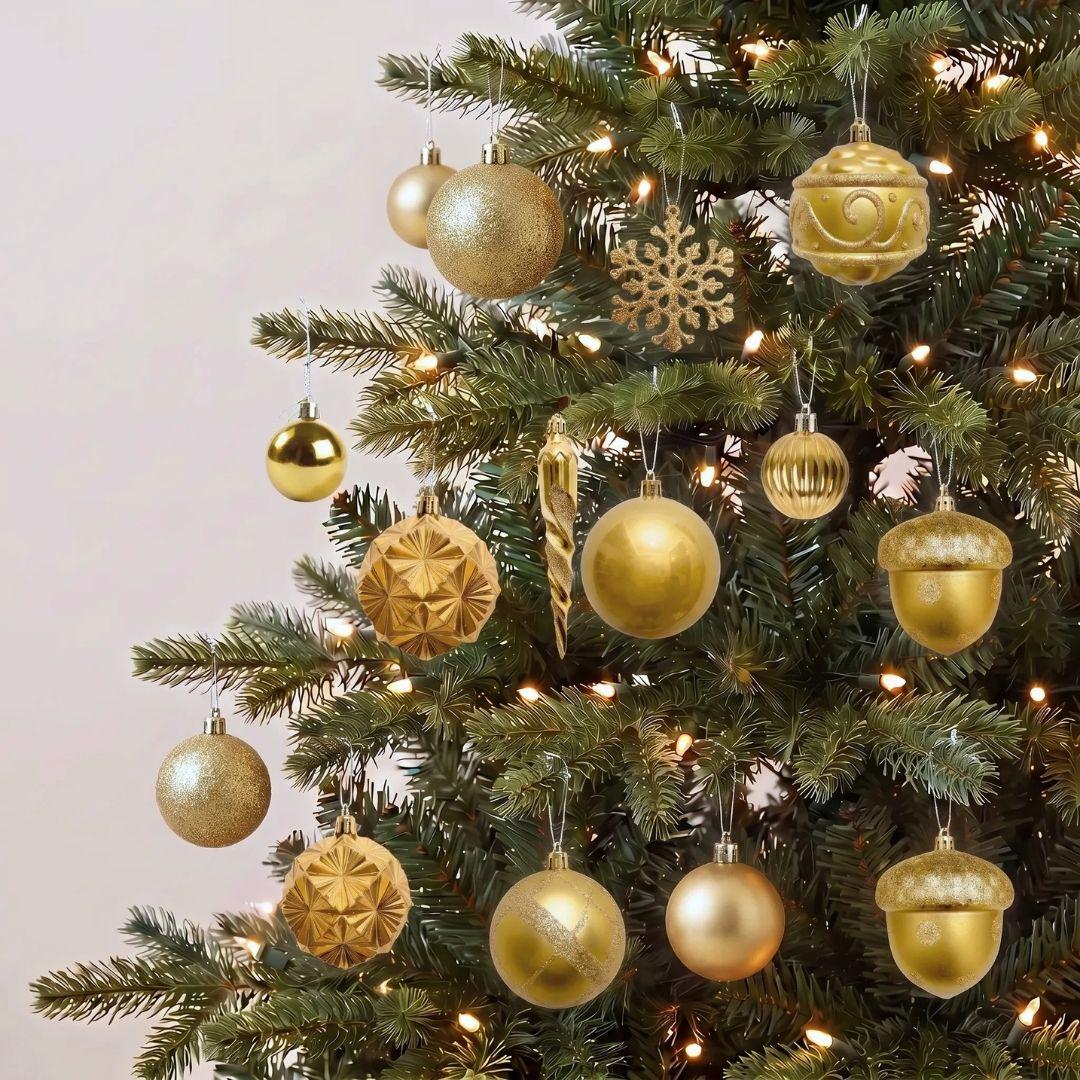
- Buy the repeating foundation. Start with a coordinated bauble set such as the 62-piece gold Christmas bauble set, or choose another set that matches the selected theme. Check pack quantity, bauble sizes and finishes rather than comparing colour alone.
- Add only the missing texture. Use hanging ornaments for character and picks or poinsettias for visible gaps. A dense tree may need very few fillers.
- Check the top and base separately. A gold star tree topper works only when its colour and scale fit the rest of the display. A structured option such as the dark brown tree collar needs to fit the stand and room finish.
- Review from the main viewing position. Look for empty zones, repeated clusters and areas where fragile pieces could be reached before opening any spare packs.
Product availability can change during the season, so treat these as examples of how to shop each layer rather than a fixed bundle. The decision method remains useful even when individual designs sell out or new colours are added. Before checkout, compare the quantity in each pack with the number of visible branches you actually need to cover, then keep a small reserve for breakage, replacements or a final balancing pass.
Match the decoration plan to the setting
| Setting | Best starting approach | What to avoid |
|---|---|---|
| Compact HDB or condo corner | Two-colour palette, restrained topper, focus on the visible sides | Too many large projecting picks that reduce walking space |
| Larger living room | Mixed ornament sizes, repeated statement pieces and a finished base | Using only small baubles, which can look flat from a distance |
| Home with children or pets | Shatter-resistant or soft pieces on lower branches, delicate pieces higher | Fragile ornaments or loose hooks at easy reach |
| Office or retail display | Simple repeatable palette that reads clearly from several metres away | Small sentimental details that disappear at viewing distance |
| Frosted or decorative tree | Fewer colours and carefully spaced accents | Covering the foliage details that make the tree distinctive |
For commercial settings, practical questions extend beyond appearance. Confirm who will assemble the tree, where cartons will be stored, whether the display needs to look complete from all sides, and how it will be dismantled after the season. A visually ambitious plan can become inefficient if the setup and storage requirements are ignored.
A final buying checklist
- Confirm tree height, widest diameter and visible viewing angles.
- Leave enough ceiling clearance for the intended topper.
- Choose warm or cool lighting before locking the ornament palette.
- Select two or three dominant colours for the base layer.
- Mix sizes and finishes instead of buying every piece in one scale.
- Add picks or poinsettias only after identifying real gaps.
- Measure the tree stand before buying a rigid collar.
- Plan storage for reusable decorations and keep protective packaging where practical.
- For children or pets, put durable pieces low and delicate pieces higher.
Frequently asked questions
Should Christmas lights go on before ornaments?
Yes. Installing and testing lights first makes it easier to distribute the glow, hide wires and correct dark areas before delicate ornaments are in the way.
How many colours should a Christmas tree theme use?
Two or three dominant colours usually create a clear foundation. Add variety through texture, finish and ornament scale rather than introducing many unrelated colours.
Do I need both a tree skirt and a collar?
No. They solve the same basic problem in different ways. A skirt gives a softer fabric finish; a collar gives a more structured base. Choose one that fits the stand and the room.
Are picks necessary on every Christmas tree?
No. Picks are useful when the foliage has visible gaps or the design needs texture and height. A dense tree with varied ornaments may not need them.
What is the safest ornament placement for homes with pets or young children?
Use softer or shatter-resistant decorations on the lower branches, secure pieces carefully, and keep fragile or heavier ornaments higher and away from frequently touched areas.

Leave a comment
This site is protected by hCaptcha and the hCaptcha Privacy Policy and Terms of Service apply.